
New at The Fixes · teacher-built · free to use

Morning Race™

A free morning-arrival classroom routine that makes unpacking, getting ready and starting work one visible sequence.

Grades 1–62–8 minutesNo student accountsClassroom launch ad-free
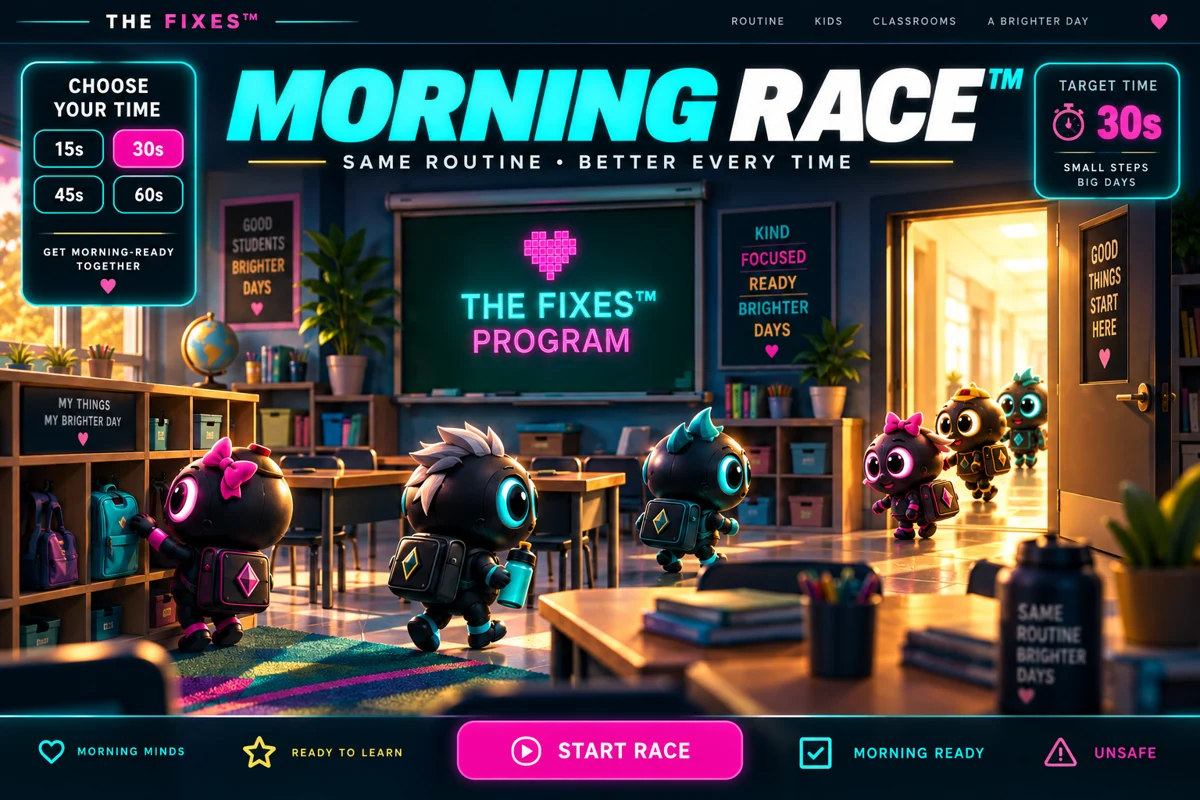
Morning Race™ cover

What this Fix is for

Morning Race is for the first few minutes when a teacher can easily spend the entire arrival block giving individual reminders. The tool turns the expected sequence into a shared start-up challenge so students can see what “ready for the day” means.

How it works

Launch it as students arrive or once the room is ready to start. Students work through the normal arrival expectations—unpack, organize, get the needed materials and reach the class’s start position. The tool provides the visible timing and finish; the teacher keeps the actual routine specific to the classroom.

Why teachers keep it simple

  • Reduces repeated morning narration
  • Works with your existing arrival routine
  • Fast enough for daily reuse
  • No student logins or devices

What students actually see

The classroom screen turns arrival into a visible sequence rather than a stream of individual reminders. Students can see what “ready for the day” means before the first lesson begins.

When to use it

Use it for morning arrival, unpacking, bell work, morning work, start-of-day routines or when students are physically in the room but the class has not really started yet.

Use it without over-explaining it

Start it as students enter or immediately after the bell. Keep the jobs in the same order—belongings away, materials ready, first task started—so the room learns the route.

Built to be reusable

A morning system should get quieter over time. If students begin the sequence without waiting for prompts, keep the structure and reduce the teacher narration.

Arrival without the reminder tour

A morning routine should work even while the teacher is helping somebody else.

Arrival is unusually demanding because students enter at different moments and the teacher is often greeting families, answering questions, handling notes or solving the first small problem of the day. A routine that depends on the teacher personally prompting every student will always feel busy, even when everyone knows the jobs.

Morning Race turns the common arrival sequence into one visible route. The goal is not to make children rush into school. It is to make “ready for the day” concrete enough that students can move through it with less individual narration.

Keep only the jobs that are truly daily

Belongings away, required materials ready and the first task started are useful because they repeat. If a step changes constantly, show the variation explicitly rather than pretending it is part of a stable routine.

Give finished students a known landing task

A morning system breaks down when the first students finish and immediately need the teacher again. Use one simple independent start task so successful early finishers do not become a new management problem.

Point to the sequence before answering “What next?”

If the display already contains the answer, use it. Repeating the next step every time prevents the visual from ever becoming the memory support it was built to be.

Separate readiness from speed

A student who throws a backpack on the floor and opens the wrong book is not “faster.” The sequence counts when the jobs are complete enough that the first lesson can begin without another round of cleanup.

Make unusual days visibly unusual

Library books, forms or special-event items can be added as a clear variation. Predictable routines survive change better when the change is named instead of whispered student by student at the door.

The best sign that Morning Race is working is not a record time. It is that the room starts needing less teacher narration. Keep the sequence; fade the performance layer when students can run it independently.