 THE
THE PROBLEM
Fast whole-class fact practice can hide which facts are actually shaky.
The teacher ends up managing responses instead of helping the class see why a fact works.
A whole-class multiplication fluency routine that remembers shaky facts, rebuilds them slowly with arrays, and brings them back when the class needs them.
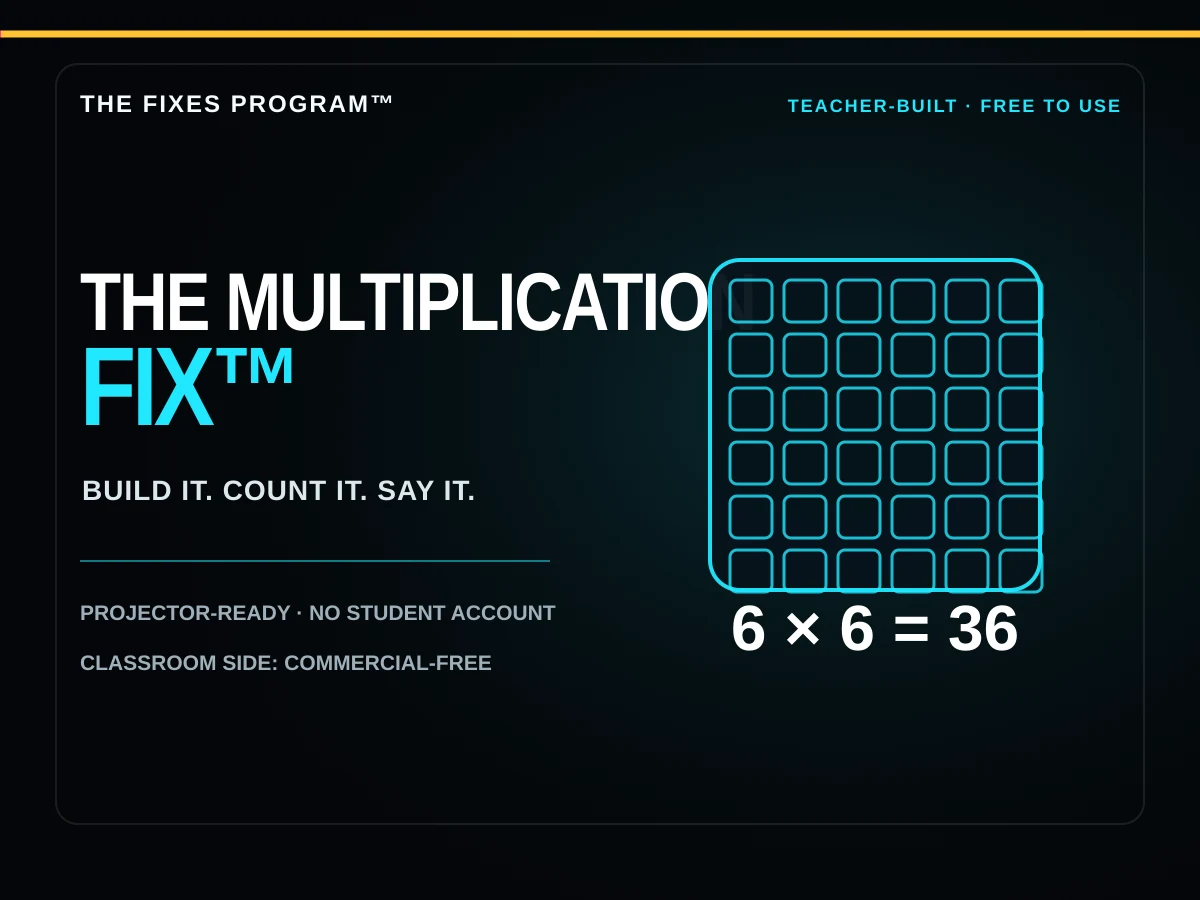
Fact fluency should not become a speed test that leaves shaky facts hidden behind louder voices.
The teacher ends up managing responses instead of helping the class see why a fact works.
The teacher listens while the engine carries the class-level memory. No names or individual scores are needed.
Build the array first, count what is actually there, then connect that structure to the multiplication fact. The visual comes before speed.
Students get quiet thinking time before anyone answers.
The class answers together, then the screen reveals the fact.
If the response sounds shaky, slow it down with an array and bring it back later.
Teacher-facing guides and support files stay here. The classroom launch remains a separate clean route.
Daily routine, class repair logic, array rule, controls and local class-memory workflow.
Teacher Guide / How-To ↗multiplication fluency · arrays · repeated addition · shaky facts · whole-class review
Open the classroom version full-screen. No advertising or payment prompt is loaded there.
Whole-class fact practice can sound fluent even when a few familiar voices are carrying the response. The Multiplication Fix deliberately inserts quiet thinking time and a repair path. When a fact sounds shaky, the array rebuilds it one row at a time so the class can connect the answer to equal groups instead of simply hearing the correct number.
The class-level memory is there to bring difficult facts back. It is not an individual scorebook and it does not need student names.
Give students enough silent time to form an answer before the class says it together. Without that pause, the routine can become an exercise in following the fastest responders.
If 6 × 4 is shaky, rebuild six equal groups of four and count what is actually there. The visual is not a penalty for getting the fact wrong; it is the representation that makes the fact explainable.
A student may understand equal groups and still retrieve slowly, or may say a fact quickly without a secure model. If the array itself is confusing, stay with the concept instead of asking for faster recall.
A repaired fact should return later so the class gets another retrieval attempt. That second encounter is more informative than simply showing the answer once and moving on forever.
Use class responses and class-level repair rather than individual speed rankings. The goal is to expose the fact that needs work without turning multiplication into a public race between students.