The problem is not the four levels
In physical education, drama, dance and health, teachers often need evidence while students are doing something. There may not be a worksheet to collect. The evidence is a throw, a sequence, a role, an explanation, a decision or a demonstration. That makes quick self-assessment attractive: show four levels, ask students where they are, and use the response to decide what happens next.
The trouble starts when the self-check quietly becomes the grade. A student points to “3,” the teacher writes down 3, and the conversation is over. That is not much of an assessment system. It is a fast number collection system.
The more useful move is to treat the level as a doorway into evidence. “You chose 2. What part can you already do?” “You chose 3. Show me what makes it independent.” “You chose 4. What could you change and still keep the skill working?” Suddenly the number is doing a job.
Make the criteria visible first
Students cannot accurately judge progress against a target they have never seen. “How good are you at dance?” is vague. “Can you perform the eight-count sequence in order, keep the beat, and use the agreed space safely?” gives the student something observable.
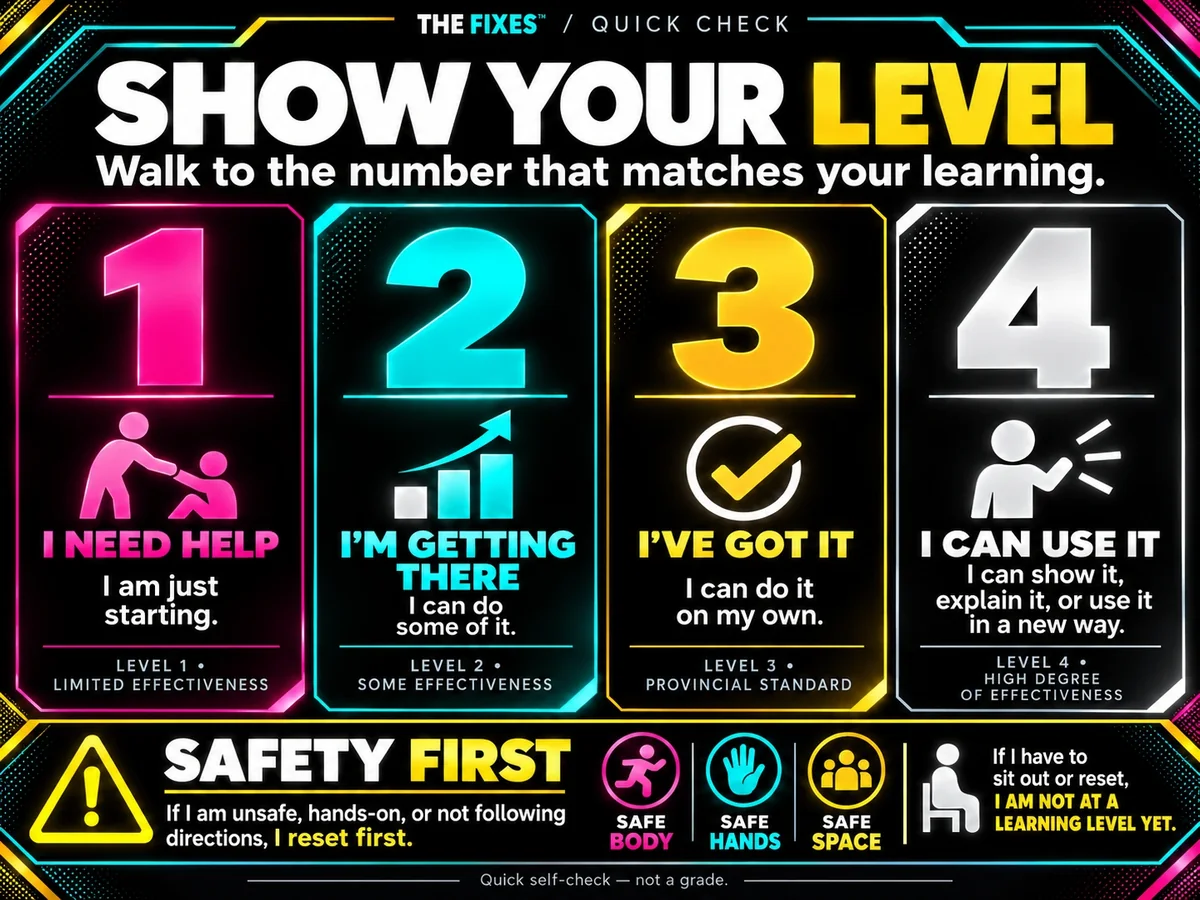
The four-level visual works best after the success criteria have already been named. Level 1 means “I need help; I am just starting.” Level 2 means “I’m getting there; I can do some of it.” Level 3 means “I’ve got it; I can do it on my own.” Level 4 asks for transfer: “I can show it, explain it, or use it in a new way.” That last level matters because it moves beyond speed or polish. A student can demonstrate understanding by adapting, explaining or applying.
What this looks like in PE
Imagine a Grade 3 class working on an overhand throw. After a few practice rounds, stop for twenty seconds. Project the levels. Ask students to show a number privately with fingers held close to their chest, or move to a numbered area if public movement feels appropriate for that group.
Do not immediately ask who is a 4. Ask a better question: “If you chose 1 or 2, what part do you want to practise next?” One group might say stepping with the opposite foot. Another might say aiming. That information can shape the next two minutes of practice far better than another whole-class explanation.
The Safety version is particularly useful in PE because performance is not the only criterion. A technically strong skill performed without awareness of space is not successful classroom movement. The visual makes safe space, safe movement and an appropriate learning level part of the same conversation.
Drama and dance need different evidence
In drama, the level might refer to how clearly a student uses voice, body and role to communicate an idea. A student at Level 2 may understand the scene but still need prompting to stay in role. A Level 4 response could be adapting the role when a partner changes the scene and explaining why the choice worked.
In dance, the criteria may be sequence, timing, control and use of space. A student can be at different levels on different criteria. That is useful information. The point is not to force the whole performance into one permanent label; it is to help the learner notice what is secure and what still needs attention.
Health can use the same structure
Health often asks students to apply ideas to situations rather than simply recall facts. A Level 3 response might be independently explaining a strategy for handling peer pressure. A Level 4 response might be applying the strategy to a new scenario and explaining why the choice changes when the context changes.
The visual stays the same. The criteria change. That consistency reduces the time spent teaching the assessment routine and gives students a familiar way to talk about progress across subjects.
Protect honest answers
Public self-assessment can become a popularity contest. If every student can see every answer, some will choose the level that feels safest socially. That does not make the tool useless; it means the response method matters.
Use private fingers, small cards, eyes-closed signals, quick teacher conferences or anonymous table responses when honesty is more important than movement. Save “walk to your level” for moments when the class culture can handle it without turning levels into teams or status.
Recheck after one targeted practice
The best comparison is not between students. It is between the same student before and after one more useful practice. Ask for a level, give a focused rehearsal, then ask again. “What changed?” is often a richer assessment question than “What number are you?”
That makes the quick check part of learning instead of a label attached after learning. It also keeps the teacher from overreacting to one snapshot. A student can move from 2 to 3 in five minutes because the missing piece was small and visible.
What not to do
Do not turn the four levels into permanent ability groups. Do not assume a student’s self-rating is automatically accurate. Do not record every response as a mark. Do not use the visual when the criteria are still fuzzy. And do not make Level 4 mean “faster” or “better than everyone else.”
Use it as a quick diagnostic: where do students think they are, what evidence do they have, and what would help next?
The practical takeaway
A four-level visual can save time because the language stays familiar. But the time savings only matter if the check leads somewhere. Keep the criteria visible. Ask for a piece of evidence. Give students one next step. Then recheck.
That is enough to make ten seconds of self-assessment useful.