Everything here is free. Use it first. If it helps, pay what it was worth.
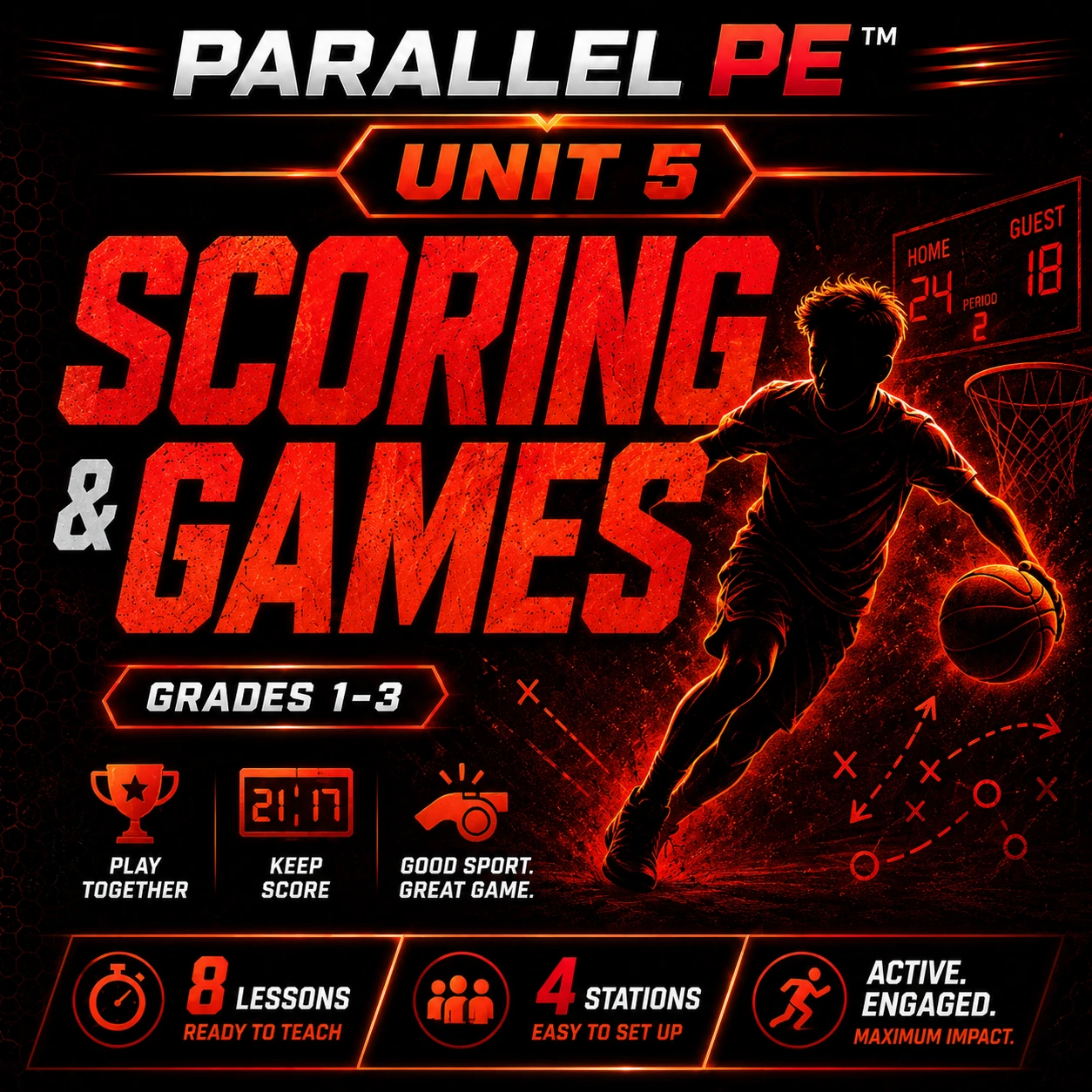
PARALLEL PE™ · UNIT 5 · 8 LESSONS

SCORING & GAMES
8 READY-TO-TEACH LESSONS.

Students build rolling, dribbling, passing, catching and object-control skills through game-like stations.

THE CLASSROOM MOMENT: You want the whole class moving at once without turning the gym into eight different explanations.
Parallel PE™ Unit 5: Scoring & Games
UNIT 5 COVERTeacher-facing product art
8lessons
4stations each
32station experiences
1repeatable layout
Why this exists

The problem is real.
So is the Fix.

Unit 5 keeps the established station architecture while skills move into scoring and game-like decisions. Rolling, dribbling, passing, catching and object control now have to survive rules, targets and changing choices.

THE PROBLEM

A game is only useful practice when the rules let students restart quickly.

The familiar station map leaves more lesson time for applying skills under simple pressure instead of learning a brand-new organizational system at the end of the unit sequence.

THE FIX

Keep the room grammar stable.

Unit 5 uses the familiar MEET HERE + four-station structure so students can focus on scoring & games.

“Same room logic. New movement problem.”
What actually happens

Open it. Run it.
Get on with the day.

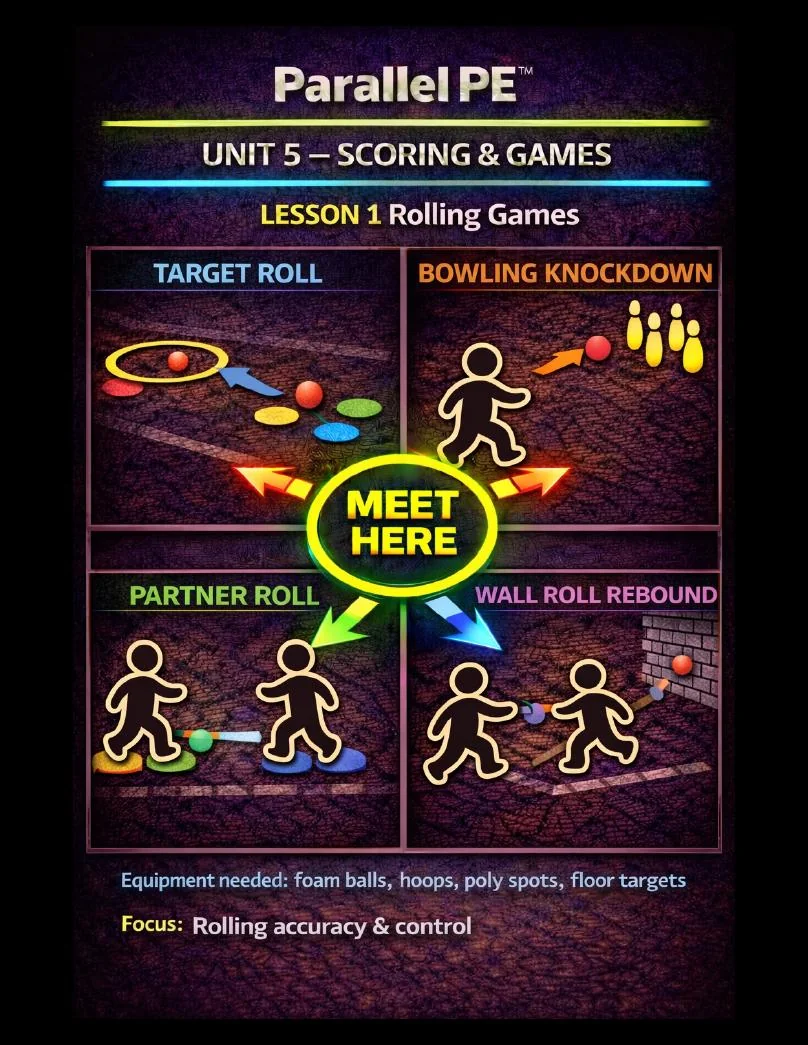
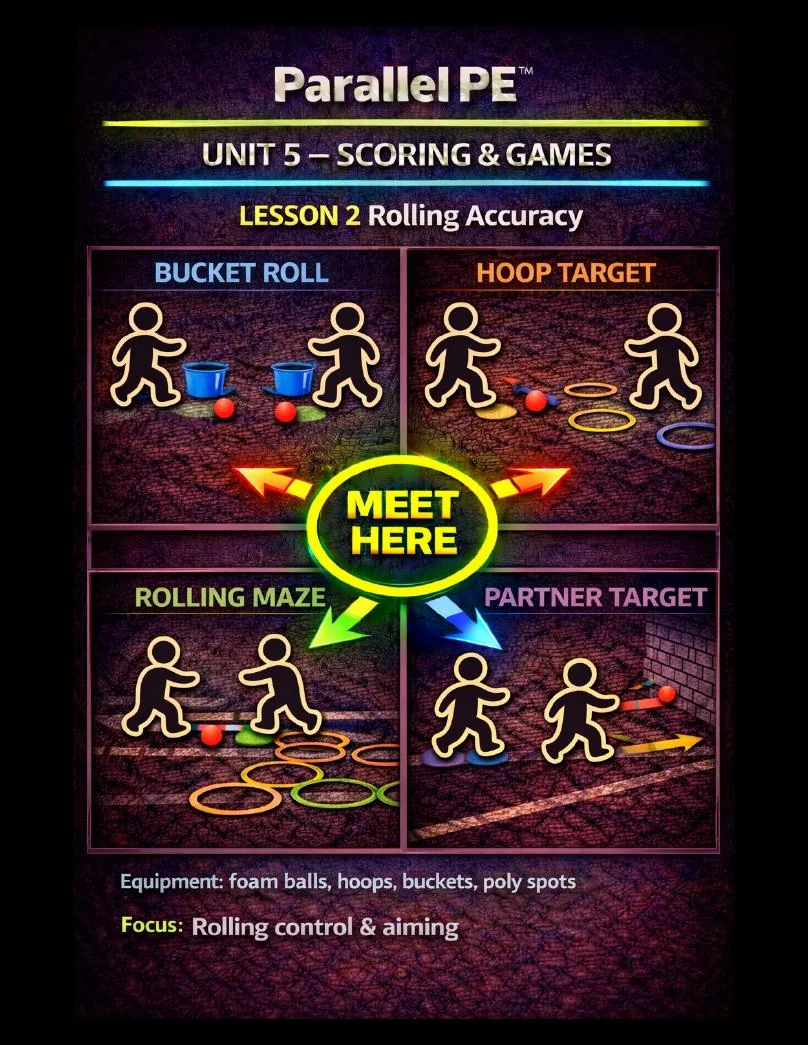
Meet at the centre, preview four stations, then let the class work in parallel.

01 · MEET

MEET

Bring the class to the central MEET HERE point.

02 · SHOW

SHOW

Use the lesson visual to preview all four stations.

03 · MOVE

MOVE

Rotate through the stations while the teacher coaches and observes.

Resource preview

A closer look.
Inside the resource.

Screens and supporting visuals from this resource.

Unit 5 teaching decisions

Use the game to reveal whether the earlier skills transfer.

Unit 5 is not a reward week after the “real” learning. The games create a new problem: can students still control, pass, catch, dribble or choose a target when there is a score, an opponent or a time pressure competing for attention? The teacher is looking for the earlier skills inside a less predictable context.

Keep the scoring system easy to restart

If students need a long discussion to decide whether a point counted, the scoring rule is stealing practice. Simplify the boundary or restart so play can continue.

Reward the skill inside the game

Notice the controlled pass, successful receive or smart space choice, not only the final point. Otherwise students learn that the score matters more than the movement behaviour the unit was built to practise.

Change numbers before adding rules

Smaller groups usually create more touches and decisions. If students are hiding in a game, reduce the group size before writing another rule that forces participation.

Finish with one transfer question

Ask what skill from an earlier unit helped in the game and where it broke down. A thirty-second reflection can connect the final challenge back to the sequence without turning PE into a lecture.

The game should make the skill harder to apply, not harder to understand. If students are confused by the rules, simplify the game until the movement problem is visible again.
Classroom side

The next click
runs the Fix.

The next route opens the actual unit pages in a clean teacher/classroom viewer. No ads or Stripe.

Open Unit 5 ↗Back to Parallel PE™
CLASSROOM ROUTE · AD-FREE