Agility breaks down when students can accelerate but cannot read space or decelerate.
The stable station map lets the teacher vary cues and pathways while students keep one reliable understanding of where each task belongs.
 THE FIXES PROGRAM™Parallel PE™ Unit 3: Direction & Agility
Students practise pathways, changes of direction and responsive movement.
Unit 3 keeps the four-station map predictable while the movement problem becomes directional: pathways, deceleration, changes of direction and responsive movement have to happen without turning the space into traffic.
The stable station map lets the teacher vary cues and pathways while students keep one reliable understanding of where each task belongs.
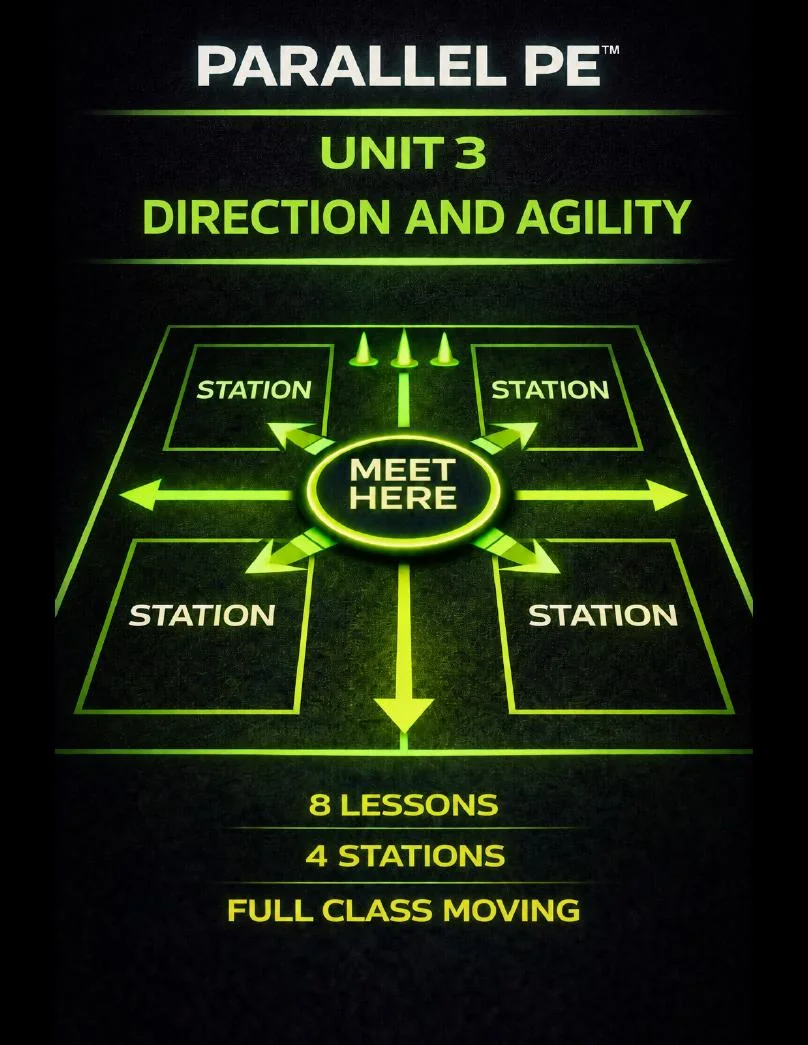
Unit 3 uses the familiar MEET HERE + four-station structure so students can focus on direction & agility.
Meet at the centre, preview four stations, then let the class work in parallel.
Bring the class to the central MEET HERE point.
Use the lesson visual to preview all four stations.
Rotate through the stations while the teacher coaches and observes.
Screens and supporting visuals from this resource.
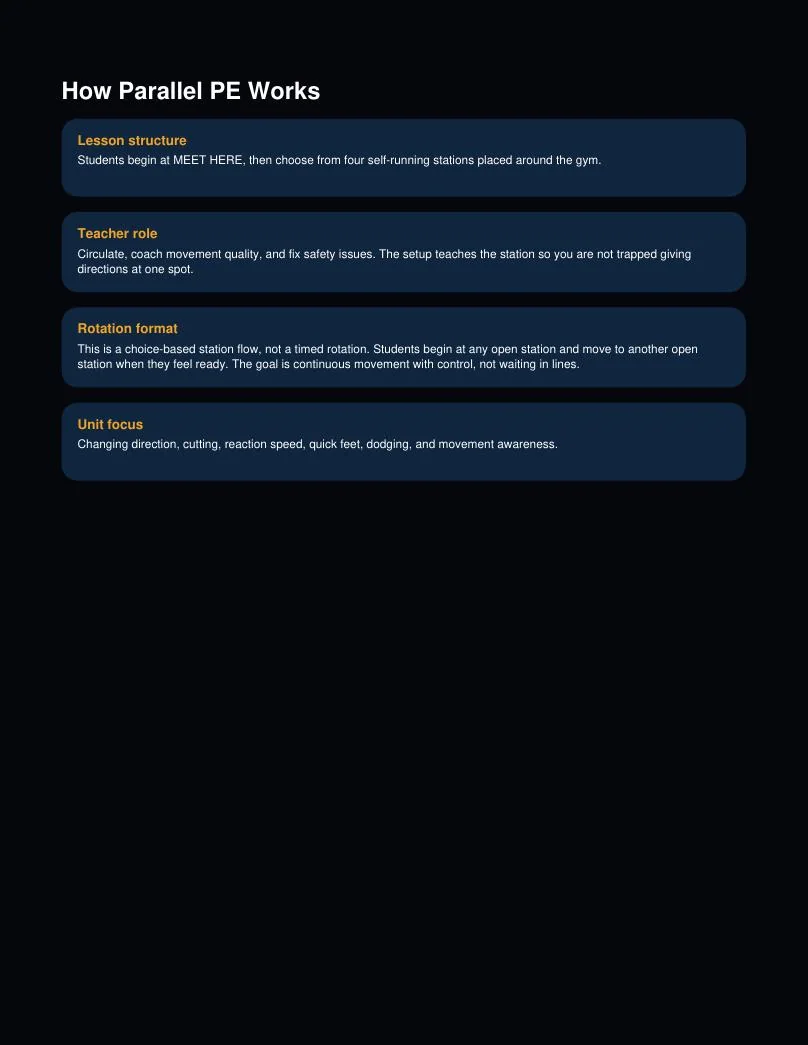
Changing direction safely requires students to read a cue, adjust the pathway and slow the body enough to make the next movement. Unit 3 works best when the teacher treats deceleration and space awareness as part of agility rather than praising the fastest cut regardless of control.
Students should understand where they may move before the direction starts changing. A clear route makes the later decision challenge safer and more meaningful.
Watch whether students can lower speed, plant and redirect without drifting into another lane. The ability to stop under control is part of the agility skill.
A colour, gesture or direction call is enough. Multiple simultaneous cues can turn the task into guessing instead of responsive movement.
Once students can change direction safely, add choice or reaction. If collisions increase, reduce the number of decisions before adding more rules.
The next route opens the actual unit pages in a clean teacher/classroom viewer. No ads or Stripe.