 THE
THE THE PROBLEM
Whole-class strategy games often turn into one student controlling the mouse while everyone else watches.
Teacher time disappears when the same moment has to be re-explained in real time.
A schoolyard capture-the-flag strategy game for ages 7–12. The screen runs the random wheel, five-second decisions, movement, prison, rescues, flags and scoring while classroom corners make the choices.

Whole-class strategy games often turn into one student controlling the mouse while everyone else watches.
Teacher time disappears when the same moment has to be re-explained in real time.
The classroom version handles the structure so the teacher can supervise the room instead of operating another complicated system.
The classroom round isolates the decisions that usually create arguments outside: where to move, when to stop and how to restart after a close call.
A true random wheel selects the next free corner.
That corner gets five seconds to point to one legal move or choose Block.
One action moves the runner and the playground announces tags, rescues, steals, prison or scoring.
Teacher-facing guides and support files stay here. The classroom launch remains a separate clean route.
Complete two-team setup, turn loop, controls and classroom guidance.
Two-Team Teacher Guide / How-To ↗A fast rules reference for the two-team edition.
Student Quick Rules ↗The six-squad version with North, Centre and South squads.
Six-Squad Teacher Guide / How-To ↗whole-class strategy · team decisions · bonus time · indoor movement · ages 7–12
Solar and Volt each split into North, Centre and South. The random six-section wheel selects one free squad at a time.
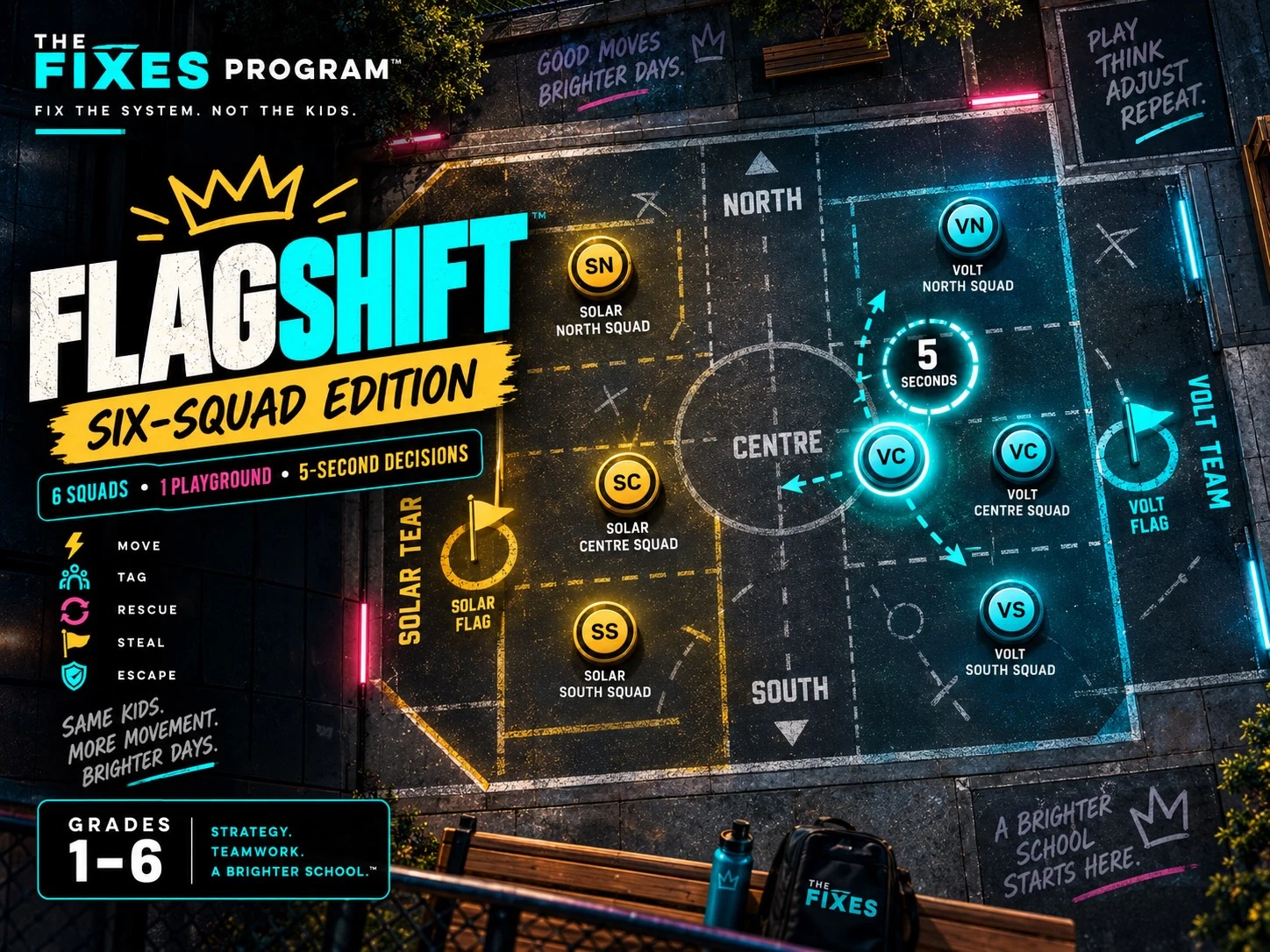
Use the same five-second decision structure with six classroom zones.
Open the classroom version full-screen. No advertising or payment prompt is loaded there.
The projected board compresses a capture-the-flag style problem into short choices. Teams get only a few seconds to decide, which makes communication and trade-offs more important than a long perfect plan. The screen carries the turn order and state so the teacher can watch whether teams are actually making decisions together.
Students need to know what counts as progress, capture, prison and rescue before the first serious choice. After that, let the repeated turns teach the structure.
A short window prevents one student from running every discussion and keeps the game moving. If a team needs longer every turn, simplify the language or roles rather than extending the whole game.
If teams are already struggling with conflict, choose a more cooperative format first. Strategy is useful only when students can accept a shared decision and move on.