You have time to fill, but not time to invent a game.
Fast oral sound and word challenges cover CVC words, blends, digraphs, vowel patterns, word families and decoding.
 THE FIXES PROGRAM™The Showdown Fix™: Phonics Edition
A projector-based phonics game with sound identification, blending, decoding, word families, nonsense words and advanced vowel patterns.
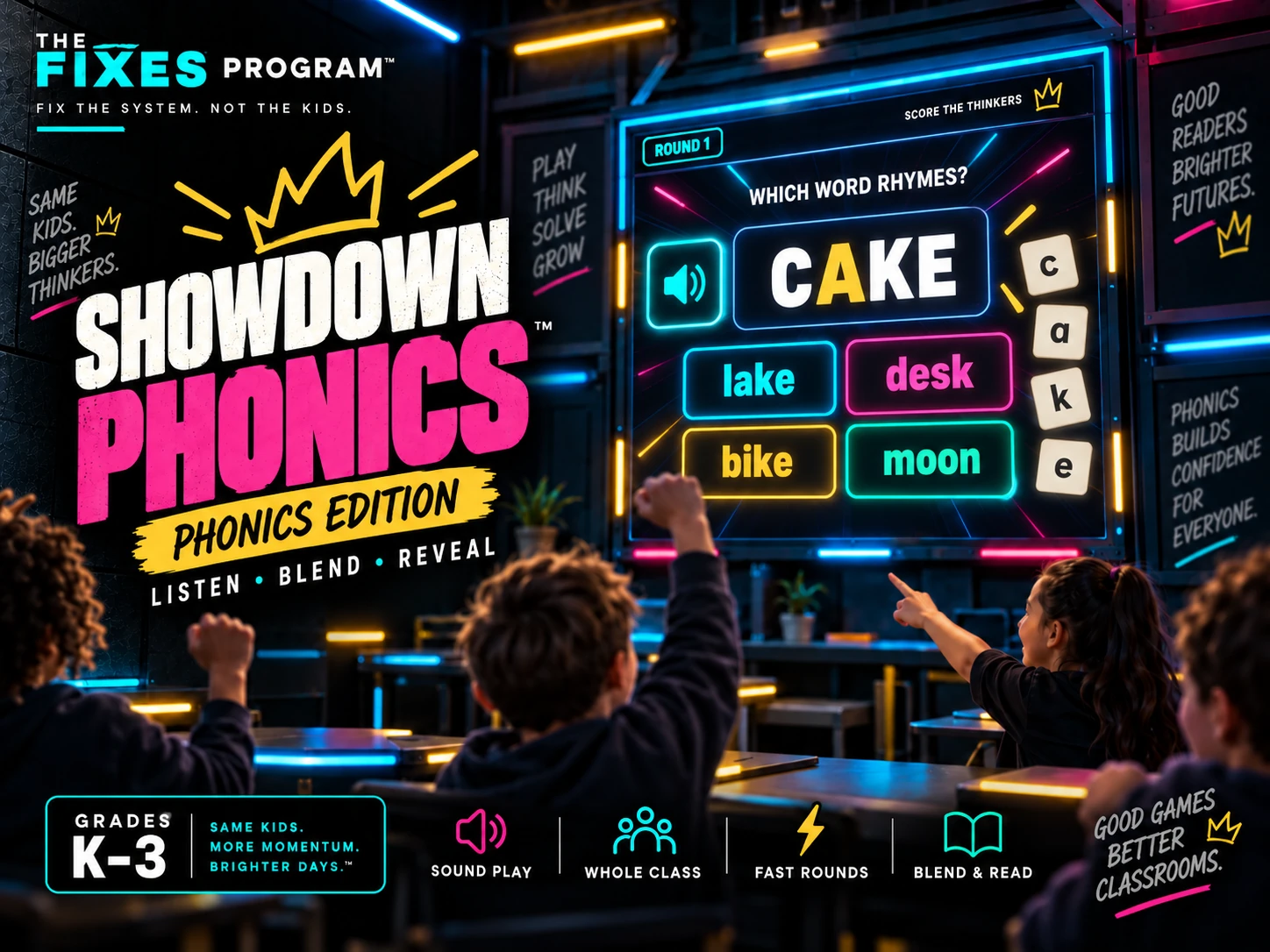
Phonics rounds make sound-pattern decisions visible and quick, letting the class practise together without individual device management.
Fast oral sound and word challenges cover CVC words, blends, digraphs, vowel patterns, word families and decoding.
A projector-based phonics game with sound identification, blending, decoding, word families, nonsense words and advanced vowel patterns.
The exact flow below comes from the actual game instructions.
Choose Quick Play or a phonics skill.
Two students respond to the sound or word challenge.
The teacher judges the first correct response.
These files are teacher-facing supports. The classroom launch remains separate and ad-free.
Printable teacher guide for setup and play.
Teacher Guide / How-To ↗The Phonics edition keeps the familiar Showdown rhythm so students can spend less attention learning the game and more attention responding to the content. The teacher still controls the quality of the prompt and the amount of thinking time before a response.
Keep the target pattern visible enough that students are practising the intended correspondence rather than guessing from context or from the loudest answer.
Give students time to map the sound pattern before the class responds. The goal is not to reward the child who recognizes the whole word first; it is to practise the intended sound–symbol relationship.
Ask students to point to or name the grapheme on selected rounds. That reveals whether the answer came from the target phonics pattern rather than from memorizing the word shape.
If the target correspondence is unstable, stop the showdown and rebuild it with a simpler example. Phonics practice should make the pattern clearer, not bury it inside faster guessing.
The next route is the actual full-screen browser game. No ads, no Stripe and no marketplace layer.