You have time to fill, but not time to invent a game.
Students move to a colour zone, lock in their choice and watch six unpredictable vault outcomes reveal automatically across three complete runs.
 THE FIXES PROGRAM™The Mastery Vault™
A one-press whole-class vault game with three five-round runs, keys, alarms, shields and a final security draw.
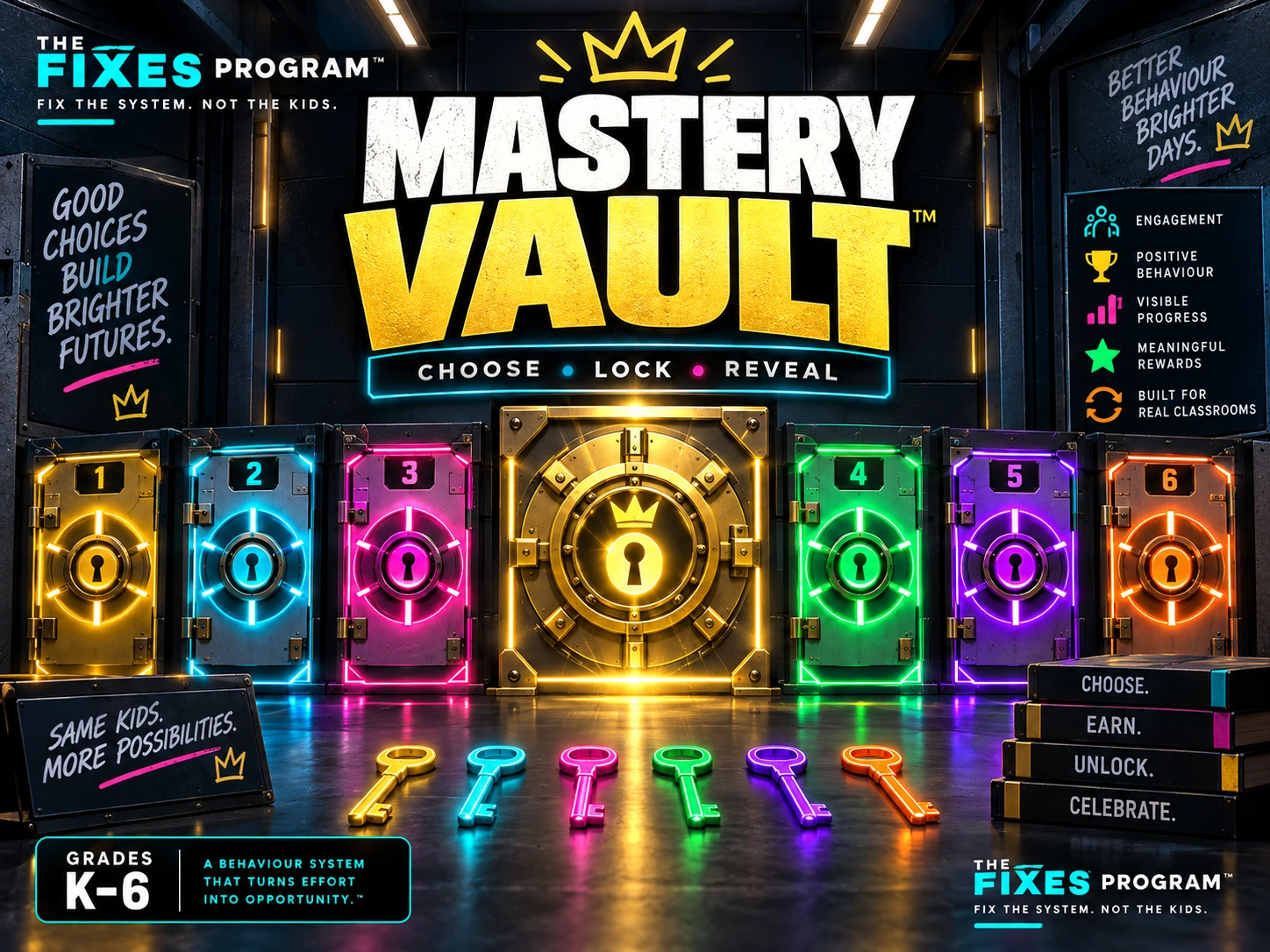
The vault sequence turns repeated classroom choices into visible progress, with one shared target instead of individual accounts or devices.
Students move to a colour zone, lock in their choice and watch six unpredictable vault outcomes reveal automatically across three complete runs.
A one-press whole-class vault game with three five-round runs, keys, alarms, shields and a final security draw.
The exact flow below comes from the actual game instructions.
Students have 30 seconds to walk to a colour vault.
Choices lock and six vaults reveal one at a time.
Keys, alarms and shields update automatically.
These files are teacher-facing supports. The classroom launch remains separate and ad-free.
Printable teacher guide for setup and play.
Teacher Guide / How-To ↗Reusable printable cards for Pink, Teal, Gold, Green, Purple and Orange — handy for games that use shared team colours or classroom zones.
Open colour cards ↗Keys, alarms, shields and vault states give repeated rounds a shared sense of movement. That can make retrieval practice feel different from another page of questions, but the game should not become the content. The teacher still decides what students are thinking about and when an answer needs explanation.
Use the vault when the class has already met the concept and needs repeated chances to retrieve, compare, justify or correct. If the idea is brand new, teach it first.
A whole-class game can reward the fastest voice if the teacher is not careful. Give everyone a short thinking window before calling for an answer or explanation. The vault should create anticipation, not turn recall into a shouting contest.
A correct response can still be a guess. Ask for strategy on selected rounds so you can hear whether students are using the intended idea. You do not need a discussion after every reveal.
Long debates about colour or vault choice slow the practice and shift attention away from the question. Let students choose quickly, lock the decision and move on.
If a question exposes a shaky idea, pause the game long enough to clarify the representation or strategy. Repeating the same prompt faster does not turn confusion into fluency.
A complete run has more value than extending the game until the class is only watching the animation. Strong endings preserve replayability and make the next use feel intentional rather than automatic.
The next route is the actual full-screen browser game. No ads, no Stripe and no marketplace layer.