THE FIXES PROGRAM™Fix the system. Not the kids.
Curriculum Fixes · math · teamwork · Grades K–8

THE CREW FIX™
THE LAST DELIVERY

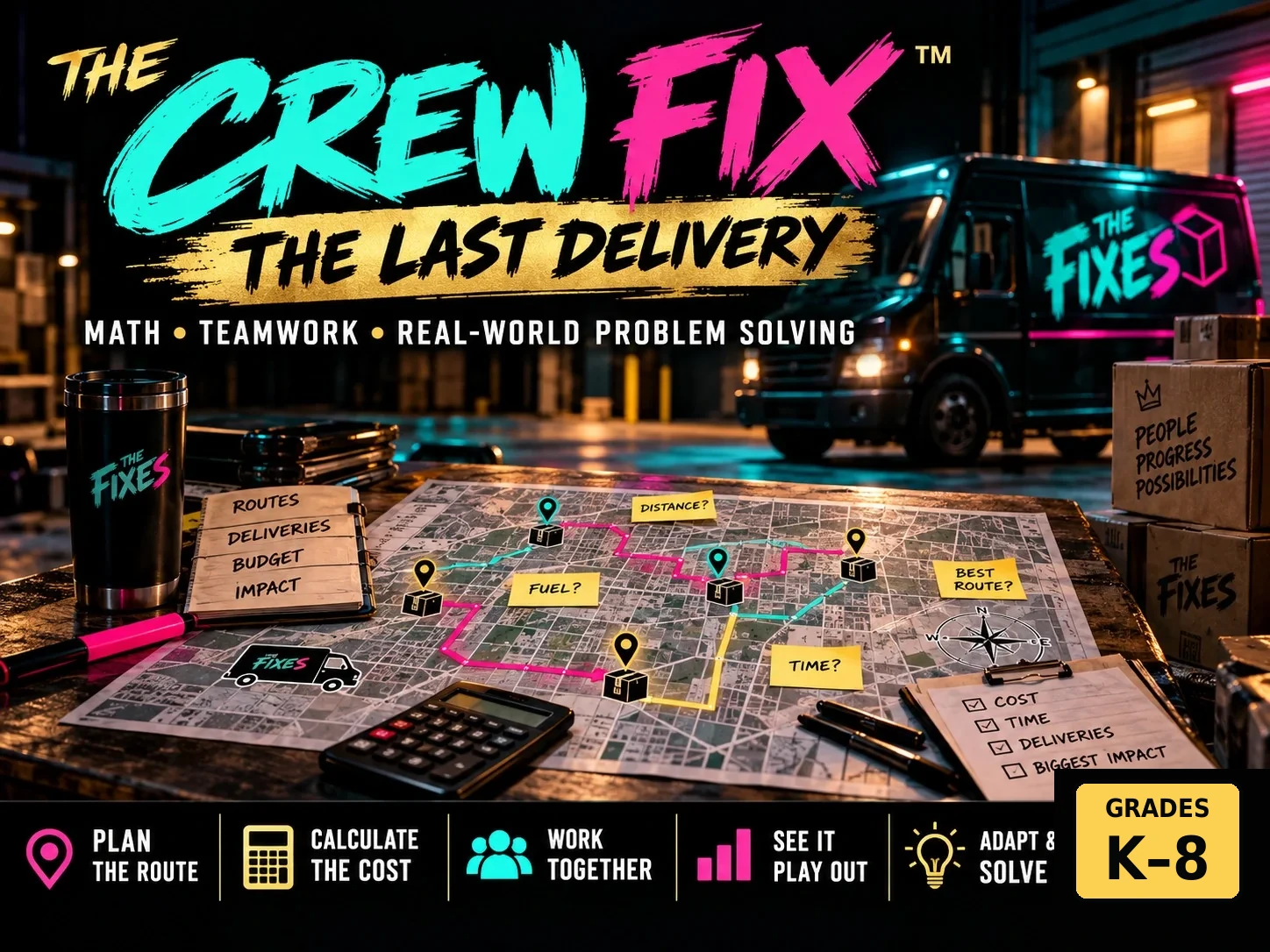
Crews plan a route, calculate the cost, commit to a decision, then watch the van follow the plan they actually chose. When the road changes, they adapt.
Guided K–1Primary 2–4Stretch 5–82–8 crewsNo student devices
The Crew Fix The Last Delivery cover
The learning loop

Plan. Calculate. Commit. Adapt.

Plan

Every crew chooses a route through the same delivery network instead of waiting for the screen to decide for them.

Calculate

Road values, fuel, delivery order and the Stretch timing rules make the mathematics part of the decision.

Watch & adapt

The van plays out the submitted route. A road closure changes round two, so crews have to revise rather than repeat.

Advertisement · teacher-facing page
Why it belongs in the library

The screen dramatizes the thinking instead of doing it.

The Crew Fix works because the most important part happens off-screen: students discuss, estimate, calculate, disagree, commit and explain. The projection makes their decision visible afterward. That keeps the tool useful for older elementary and middle-years learners who want competition and consequence without turning the lesson into a click-through game.

The Primary band now explicitly includes Grade 4, closing the gap in the original build. Teachers can still use Guided K–1 for small values and extra fuel, or Stretch for larger values, priority timing and a more demanding route decision.

One projector. Every crew thinking.

Students can work on paper or whiteboards. No names, student accounts, ads or network requests are needed in the classroom runtime.

Why this works in a real classroom

The calculation matters because the decision has somewhere to go.

Many group-math tasks stop at the worksheet. Students calculate, compare answers and move on. The Last Delivery keeps the arithmetic attached to a shared decision. A crew has to read the route information, decide what matters, commit to a plan and then watch the van follow that choice. That visible consequence gives students a reason to explain why one route is better than another instead of treating every number as an isolated exercise.

The challenge levels are intentionally broad. Guided mode uses smaller values and extra fuel for Kindergarten and Grade 1. Primary mode now covers Grades 2–4. Stretch mode covers Grades 5–8. The structure stays the same across the bands, but the size of the numbers and the amount of strategic pressure change. That means a teacher can preserve the cooperative routine while adjusting the mathematical demand.

Use the crew before you use the screen.

The best version starts away from the projector. Give each crew paper or a whiteboard. Ask them to calculate, choose and explain before anything moves on screen. Once crews have committed, the projected route becomes feedback rather than the source of the thinking. If conditions change, the class has to adapt from evidence instead of guessing what the teacher wants.

What to listen for

Strong crew talk usually sounds like comparison: “This one costs less, but that one is faster.” “We can afford Route B, but we lose flexibility.” “If that road closes, our first plan is weaker.” Those sentences matter more than whether every crew chooses the same route. The goal is not one perfect answer; it is a better decision backed by visible reasoning.

For repeat use, change the crew roles rather than adding more rules. One student can track cost, one can watch time, one can challenge the route, and one can prepare the explanation. Rotate those jobs next time. The mission stays familiar while the thinking responsibility moves.

Good curriculum fit

Number sense, operations, measurement, proportional thinking, data comparison, mathematical communication and collaborative problem solving.

Good classroom fit

One shared screen, small crews, low setup, no student accounts and a clean finish that gives the teacher a natural debrief point.

Related Field Note: When group work needs a real decision explains why cooperative tasks improve when students have to commit, compare and adapt.